
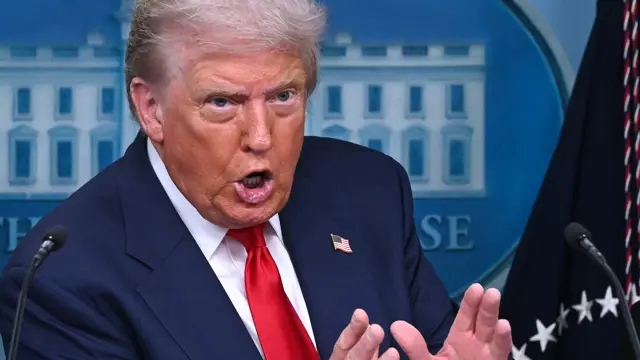


The UN Security Council has formally approved a U.S.-drafted resolution endorsing President Donald Trump’s 20-point plan for Gaza, marking a major step in efforts to stabilize the region after years of conflict.
Central to the plan is the creation of an International Stabilisation Force (ISF), which the United States says has received pledges of support from multiple, though unspecified, countries. The force is intended to work with Israel, Egypt, and a newly trained and vetted Palestinian police unit to secure border areas and support the permanent disarmament of non-state armed groups, including Hamas.
The resolution passed with the backing of 13 council members, including the United Kingdom, France, and Somalia, with no votes against. Russia and China abstained, citing concerns over the plan’s clarity and its implementation mechanisms.
A spokesperson for UN Secretary-General António Guterres described the adoption of the resolution as “an important step in the consolidation of the ceasefire,” highlighting the international community’s push to end hostilities and facilitate reconstruction efforts.
Hamas, however, has rejected the resolution, calling it inadequate in addressing Palestinian rights and demands. In a statement posted on Telegram, the group accused the plan of imposing “an international guardianship mechanism on the Gaza Strip,” warning that the ISF’s mandate, which includes disarming Palestinian factions, would compromise its neutrality and effectively make it “a party to the conflict in favour of the occupation.”
Under the resolution, the ISF is expected to coordinate closely with Israel and Egypt, alongside the newly established Palestinian police force, to enforce security measures and oversee disarmament. Until now, the Gaza police operated under Hamas authority, leaving much of the territory’s security under the control of the militant group.
Trump’s Gaza Plan Gains UN Security Council Support
Mike Waltz, the U.S. ambassador to the United Nations, described the ISF’s mission as multifaceted: “Securing the area, supporting the demilitarisation of Gaza, dismantling the terrorist infrastructure, removing weapons, and ensuring the safety of Palestinian civilians.”
The Security Council also approved the formation of a transitional governance entity known as the Board of Peace (BoP), which will oversee a Palestinian technocratic committee tasked with reconstruction and humanitarian aid delivery. Funding for rebuilding Gaza after two years of conflict will come from a trust fund administered by the World Bank, according to the resolution.
Both the ISF and the BoP are expected to operate alongside the Palestinian committee and the new police force, ensuring coordination on the ground. President Trump described the Security Council’s endorsement as “historic,” adding on his social media platform, Truth Social, that the resolution represents “one of the biggest approvals in the history of the United Nations” and would “lead to further peace all over the world.” Trump is expected to chair the BoP once its final membership is announced.
Unlike previous drafts, the approved resolution explicitly references a pathway to Palestinian self-determination and statehood, language advocated by several council members. However, Israel strongly opposes the creation of a Palestinian state, presenting a significant obstacle to long-term peace. Arab states had pushed for the inclusion of language supporting Palestinian self-determination, reflecting regional priorities and the concerns of the Palestinian Authority.
The UN Secretary-General’s office emphasized that the resolution must “translate… into concrete and urgently needed steps on the ground” and serve as a foundation for “a political process for the achievement of the two-state solution.” The United States, Palestinian Authority, and a number of Arab and Muslim-majority nations, including Egypt, Saudi Arabia, and Turkey, have urged rapid implementation. The Palestinian Authority stressed that the resolution’s measures should be enacted “urgently and immediately.”
Russia and China, while abstaining rather than vetoing the resolution, criticized it for lacking clarity regarding the composition of key mechanisms, insufficient UN involvement, and failing to explicitly reaffirm the two-state solution.
The initial phase of Trump’s plan, which established a ceasefire between Israel and Hamas and addressed the transfer of hostages and detainees, came into effect on 10 October. Waltz described this first stage as “fragile, fragile,” highlighting the delicate nature of the process.
The plan effectively halted fighting that erupted after a Hamas-led attack on Israel on 7 October 2023, which left 1,200 people dead and 251 taken hostage. Since then, according to the Hamas-run Gaza health ministry, Israeli military actions have claimed more than 69,483 Palestinian lives.
The Security Council’s vote marks a pivotal moment in international efforts to stabilize Gaza, rebuild infrastructure, and establish a framework for longer-term peace. Whether the ambitious plan can achieve these goals, however, remains uncertain, given the deep political and territorial divisions that continue to challenge Israel, the Palestinian territories, and the wider region.
Source- BBC