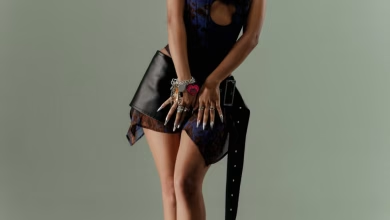
When Rihanna released “Disturbia” in the summer of 2008, the song quickly proved that the Barbadian superstar was more than just a rising star—she was an unstoppable force shaping the sound of the decade. Critics immediately hailed the single as a perfect example of her evolving artistry, and the song’s chart performance reflected its instant impact.

In the July 5, 2008, issue of Billboard, music critic Michael Menachem praised the track, writing, “It’s safe to say that Rihanna is the premier artist of the second half of the decade, with no signs of wear and tear.” Menachem highlighted “Disturbia” as a “sort of ‘Thriller’ for partygoers,” noting its multilayered vocals that cascaded across Rihanna’s lower register, punctuated by playful scatting reminiscent of the catchy ‘bum bum bi dum bum’ chorus. The review emphasized Rihanna’s growing status as a cultural touchstone, declaring her the “trustworthy ‘it’ girl of our time.”
The single made an impressive debut on the Billboard Hot 100, entering at No. 18 during its first week—a notable leap for Rihanna, who had previously never opened a single in the top half of the chart. Her previous highest debut had been No. 51 with “Unfaithful” in May 2006. Seven weeks after its release, “Disturbia” reached No. 1 on the Hot 100 dated August 23, 2008, where it remained for a two-week reign. This marked Rihanna’s fourth chart-topping single, following “Take a Bow” (one week at No. 1 in May 2008), the seven-week megahit “Umbrella” featuring Jay-Z (June-July 2007), and “SOS” (three weeks at No. 1 in May 2006).
Chart Rewind: Rihanna’s ‘Disturbia’ Dominates 2008 and Cemented Her Status as Pop’s Unstoppable Force
“Disturbia” and “Take a Bow” were part of the deluxe Reloaded edition of Rihanna’s 2007 album Good Girl Gone Bad, released in June 2008. Meanwhile, “Umbrella” had originally introduced audiences to the album’s darker, edgier sound when it debuted a year earlier. This pattern underscored Rihanna’s consistent ability to blend mainstream appeal with innovative production choices, keeping her fans engaged and critics impressed.
The track was produced solely by Brian Kennedy, marking his first time topping the Hot 100 as a producer. Kennedy would go on to achieve further chart success, contributing to Kelly Clarkson’s “Mr. Know-It-All” (No. 10, November 2011) and Chris Brown’s “Don’t Wake Me Up” (No. 10, November 2012). More recently, he reached the charts with The Weeknd’s “Here We Go… Again” featuring Tyler, The Creator in 2022, illustrating the longevity of his influence in the pop and R&B arenas.
Beyond the Hot 100, “Disturbia” also performed strongly across multiple formats. The single topped the Pop Airplay chart, highlighting its radio-friendly appeal, and the Dance Club Songs chart, showcasing its success in nightclubs and among DJs. Its blend of pulsating beats, dark pop sensibilities, and Rihanna’s distinctive vocal delivery made it both a commercial hit and a favorite among critics and fans alike.
The song’s acclaim extended to awards recognition as well. “Disturbia” was nominated for Best Dance/Electronic Recording at the 2009 Grammy Awards, reinforcing Rihanna’s versatility and ability to excel across genres. Its success solidified her as one of the defining voices of her generation, capable of merging pop, R&B, and dance influences in ways that felt fresh and forward-thinking.
The track’s impact also marked a key moment in Rihanna’s career trajectory. By 2008, she had already demonstrated a remarkable ability to consistently deliver hits, but “Disturbia” showcased her skill at pushing creative boundaries. Its darker themes, combined with playful, hypnotic vocal patterns, revealed an artist unafraid to experiment, setting the stage for future work that would continue to challenge pop conventions.


Looking back, “Disturbia” is more than just a chart-topper; it is a cultural touchstone that captures Rihanna at a pivotal point in her career. The single’s commercial and critical success cemented her status as a global pop icon, a trendsetter whose influence extended beyond music to fashion, culture, and the broader entertainment landscape.
Even more than a decade later, “Disturbia” remains a fan favorite, celebrated for its infectious hooks, darkly playful energy, and Rihanna’s magnetic presence. It is a reminder that at the peak of the 2000s pop era, Rihanna wasn’t just participating in the conversation—she was defining it.
Source- BillBoard