
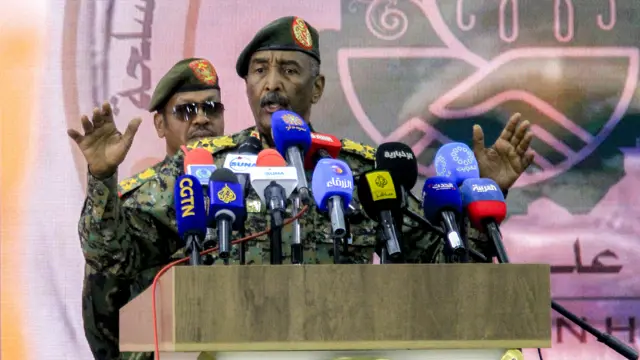


Sudan’s devastating civil war, now stretching beyond eighteen months, has taken yet another dramatic turn as the country’s army chief, General Abdel Fattah al-Burhan, publicly called on U.S. President Donald Trump to intervene and help bring an end to the conflict. In a strongly worded op-ed published by The Wall Street Journal, Burhan appealed directly to Washington, urging Trump to take decisive steps toward peace in Sudan, where millions continue to suffer.
The conflict, which began in April 2023, pits Burhan’s Sudanese Armed Forces (SAF) against the Rapid Support Forces (RSF), a powerful paramilitary faction led by his former deputy, Mohamed Hamdan Daglo—better known as Hemedti. Over the past year and a half, the war has killed tens of thousands of civilians, displaced more than 12 million people, and triggered what aid agencies now call the world’s largest hunger and displacement crisis.
Burhan’s appeal comes at a moment when the international community is desperately searching for a path toward de-escalation in Sudan. “The Sudanese people now look to Washington to take the next step,” he wrote, calling Trump a leader “who speaks directly and acts decisively.” According to Burhan, many Sudanese citizens believe that Trump has the political resolve needed to confront foreign powers they accuse of fueling the conflict.
Sudan’s Crisis Draws Renewed Attention from Washington
Trump only recently expressed interest in the war in Sudan, reportedly after receiving direct encouragement from Saudi Crown Prince Mohammed bin Salman, who urged him to play a more active role. The former U.S. president soon vowed that he would bring an end to the conflict, marking his most significant public involvement since fighting broke out in 2023.
Burhan’s op-ed appears to be a direct attempt to leverage that renewed attention. He argued that peace in Sudan requires the involvement of global partners willing to pressure all sides—especially alleged foreign backers of the RSF. Although he did not explicitly name the United Arab Emirates in his article, Burhan has repeatedly accused the UAE of supplying arms and support to the RSF. Abu Dhabi has consistently denied the allegations.
Today, global powers including the U.S., UAE, Saudi Arabia, and Egypt are attempting—once again—to negotiate a ceasefire in Sudan. Past talks, most notably those hosted by the U.S. and Saudi Arabia in Jeddah, were unsuccessful, with both the SAF and RSF refusing to adhere to agreed-upon terms or pulling out of discussions altogether.
Since April 2023, the war in Sudan has escalated into one of the world’s most catastrophic humanitarian disasters. Cities such as Khartoum, El Geneina, Nyala, and Omdurman have been ravaged by airstrikes, artillery shelling, and urban warfare. Entire neighbourhoods lie in ruins, and millions of civilians have fled to neighbouring countries—including Chad, Egypt, and South Sudan—in search of safety.
The RSF has been accused of widespread atrocities, particularly in the western region of Darfur. In January, the U.S. formally determined that the RSF had committed genocide, documenting mass killings, sexual violence, and ethnically targeted attacks. However, Burhan’s own forces have also been implicated in numerous abuses, including indiscriminate shelling of residential areas and attacks on civilians.
In his op-ed, Burhan attempted to position his army as the legitimate defender of the Sudanese state, writing that the conflict is a choice “between a sovereign state trying to protect its citizens and a genocidal militia bent on destroying communities.” He emphasised that his government remains the internationally recognised authority in Sudan, despite the widespread destruction seen across the country.
The power struggle between Burhan and Daglo has deep roots. The RSF, originally formed from the notorious Janjaweed militias, was contracted by Khartoum over the years to fight in the country’s peripheral conflicts. When the uprising of 2018–2019 toppled longtime dictator Omar al-Bashir, Burhan and Daglo became close allies in the transitional government—only to jointly oust civilian leaders in a 2021 coup.
But their uneasy alliance unraveled as both men sought control over Sudan’s political transition and security forces. By early 2023, tensions reached breaking point. On 15 April 2023, the dispute exploded into all-out war, plunging Sudan into chaos and dismantling years of progress toward democracy.
Burhan now claims he “long recognised that the RSF was a powder keg,” though critics argue that both leaders contributed significantly to Sudan’s instability.
As Sudan continues to spiral deeper into violence, Burhan’s call for Trump’s intervention signals both desperation and political strategy. Many fear that without firm international pressure on both sides, the conflict will drag on, causing even greater devastation.
The road to peace remains uncertain. But with millions displaced, famine looming, and regional tensions rising, the world’s eyes may once again turn toward Sudan—a nation crying out for decisive global action.
Source- EWN